The Kerb-Side Kit: Turning a Puncture Into a Five-Minute Stop
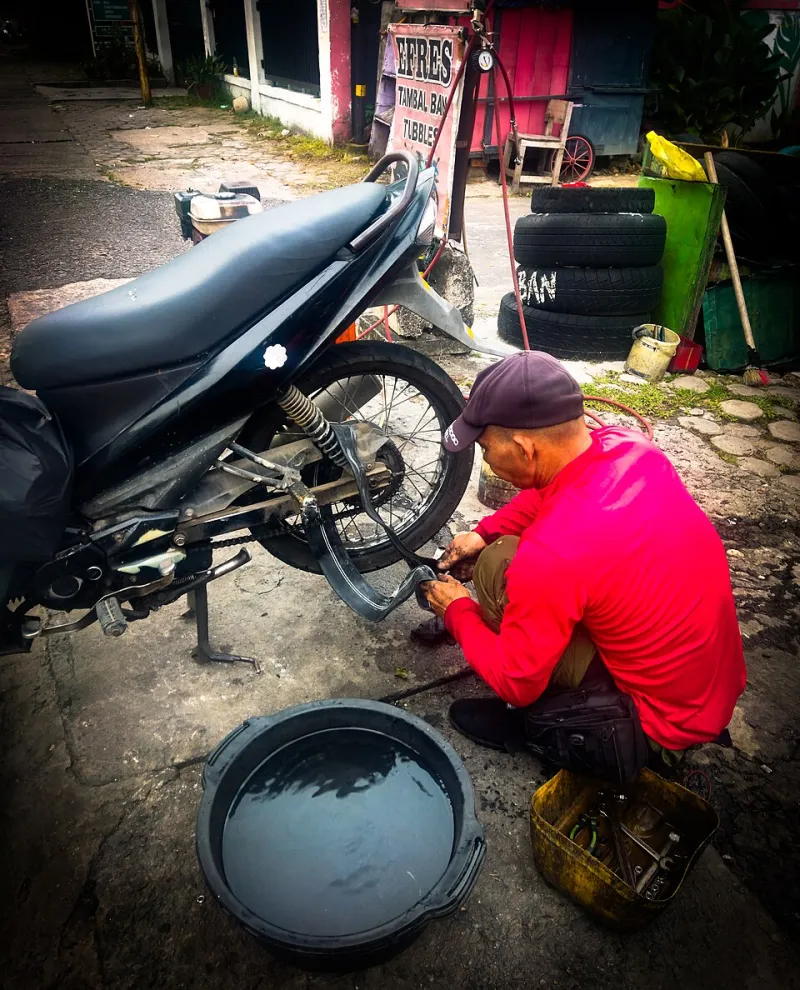
Photo: Muhamad Izzul Fiqih, CC BY-SA 4.0, via Wikimedia Commons
A puncture does not care that you finally got the weather window right. It does not care that you are twenty miles from home, that the B-road has more potholes than tarmac, or that your phone is showing one bar and a hopeful little dot. It just happens. The difference between a five-minute kerb-side stop and a ruined Sunday is usually not luck. It is preparation, a small kit, and a clear idea of what you are willing to tackle at the side of the road.
First, work out what sort of puncture you have got
Most modern road bikes run tubeless tyres. That is good news, because a tubeless tyre can often be plugged without removing the wheel. It is not a permanent repair, but it can get you home or to a garage. Spoked wheels may still run tubes unless they have been sealed, and older or smaller bikes often do too. Know which system you have before you need to know. Check the valve, the rim and the tyre sidewall, and if you are unsure, ask a mechanic. It sounds basic, but discovering your bike has a tube while kneeling in the rain is not the moment to start guessing.
Have a proper look before you start jabbing tools into anything. A slow puncture from a small nail is one thing. A torn sidewall, a sliced valve, or a big gash is another. If the tyre is visibly flat, do not ride it even slowly. A few hundred yards on a flat can wreck a tyre, a rim, and your mood. Get off the traffic side, put the bike on the side stand or centre stand if you have one, and switch on your hazard lights if fitted.
The tubeless plug kit is the quiet hero
A decent tubeless plug kit is small, cheap and genuinely useful. You want a reamer, an insertion tool, some sticky strings or mushroom plugs, rubber cement if your kit uses it, a sharp knife, and gloves. Keep it under the seat or in a small tank bag. The principle is simple: clean out the hole, push the plug in, trim the excess, inflate, and check for leaks. The reality is that you need to have practised it at least once. Trying to thread a sticky plug with cold hands for the first time at the side of an A-road is not a good introduction.
Know the limits. Plugs are for tread-area punctures, not sidewalls. They are not for large tears, and they are not for a tyre that has been run flat and damaged internally. If two holes are close together, or the tyre is old and tired, be honest with yourself. A plug is a get-you-going repair, not a licence to ignore the tyre until MOT time. Get it properly inspected and repaired or replaced as soon as you can.
Tubes, levers and the roadside wheel-out
If your bike runs tubes, your kit needs to be different. Carry a spare tube in the right size, a set of decent tyre levers, a pump, and any tools needed to remove your wheel. That last part is where many riders come unstuck. Some bikes have a single-sided swingarm and a big nut. Some have chain adjusters that need spanners. Some have a front axle that needs a specific hex key. Check your own bike before you build the kit.
Changing a tube at the roadside is doable, but it is not a five-minute job for most people. It helps to know how to break the bead, how to avoid pinching the new tube, and how to get the wheel back in straight. Practise in a garage or on a dry driveway first. If you are running tubeless tyres with tubes inside, carry a tube anyway. A plug will not help you if the puncture is in the tube and the tyre will not hold air.
Air: CO2 cartridges versus a mini pump
CO2 inflators are fast and compact. They can seat a tubeless bead in the right circumstances, and they get you back on the road quickly. They are also finite. Use one badly and you have a very expensive hiss. CO2 can also leak out of some tubes faster than air, so check your pressure again soon after. Keep the inflator insulated or use gloves, because the cartridge gets cold enough to hurt.
A mini pump is slower and more tiring, but it never runs out. Many riders carry both: a pump for control and a couple of CO2 cartridges for speed or bead-seating. Whatever you carry, include a small pressure gauge. Plugging a tyre and then riding on 15 psi because you guessed is not a plan. It is a wobble waiting to happen.
Signal, recovery and knowing when to stop
Britain is very good at many things. Reliable mobile signal on rural B-roads is not always one of them. Before a long ride, tell someone your route, download offline maps, and carry a charged phone and a power bank. If you have breakdown cover, read the small print before you need it. Does it cover punctures? Does it recover you home or to a garage? Is there a distance limit? Is bike-specific recovery included? A policy that looks cheap can get very expensive when the recovery truck is fifty miles away.
Calling recovery is not a failure. If it is dark, if you are on a motorway shoulder, if the puncture is in a sidewall, if your wheel will not come out, or if you simply do not feel safe, stop. A phone call and a wait in a lay-by is far better than a risky repair in poor light. The best riders are not the ones who never call for help. They are the ones who know when to.
The kit that actually fits under the seat
Keep it compact and check it once a year. A sensible starting point is a tubeless plug kit, a mini pump, two CO2 cartridges, a pressure gauge, a spare tube if your bike needs one, tyre levers, a small torch, cable ties, a bit of tape, gloves, and a basic multi-tool that actually fits your bike. Add a fiver in cash and a written recovery number. Then practise using the important bits. A kit you have never opened is just extra weight.
A puncture plan is really a mindset. Build the kit, learn your bike, know your limits, and accept that some days the right tool is a recovery truck. That is not bad luck. That is good judgement.