Reading the Rubber: What Your Tyre Wear Is Trying to Tell You

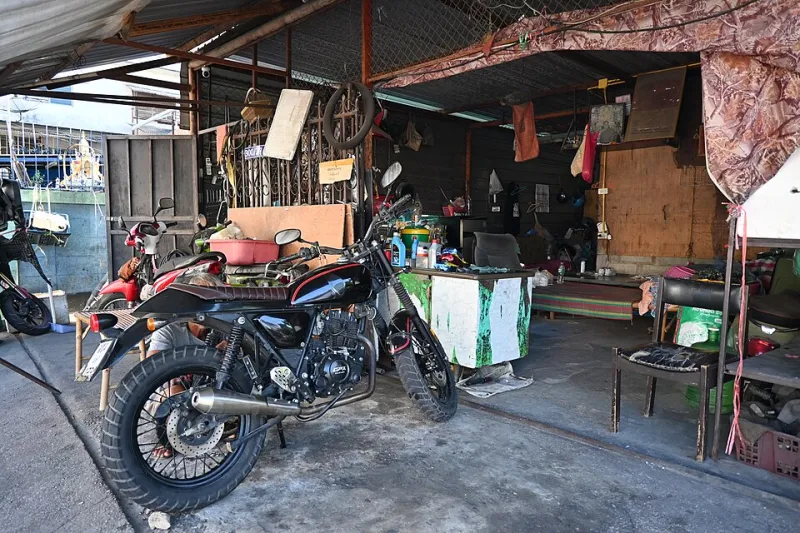
Photo: RahimMngwaya, CC BY-SA 4.0, via Wikimedia Commons
Tyres are the most honest component on a motorcycle. They cannot lie, they cannot hide, and they record everything — every under-inflated commute, every pothole you pretended not to see, every time your suspension was set up for a rider twenty kilos lighter than you.
The trouble is that most of us only look at a tyre when it is obviously bald, and by then the conversation is over. Reading wear patterns is a genuinely useful skill, and it costs nothing but ten minutes a month with a torch and a pressure gauge.
Ten minutes, once a month
Pick a dry Sunday morning, before you ride, when everything is cold. Cold matters — a tyre that has just done forty miles will read several psi higher and hide a slow leak.
- Check pressures against the handbook figure, not the number on the sidewall. The sidewall figure is a maximum, not a recommendation.
- Run a thumb across the tread at three points: centre, and both shoulders. You are feeling for shape, not just depth.
- Look at the tread wear indicators — the little raised bars inside the grooves. If the tread is level with them, you are done.
- Get down and look at the sidewalls for cracking, bulges or scuffing.
- Spin the wheel and watch the tyre as it turns. A wobble or a pronounced low spot will show up here before it shows up under braking.
- Find the four-digit date code on the sidewall. Week and year. Anything approaching five or six years old deserves a hard look regardless of tread depth.
That is the whole routine. Everything below is just interpretation.
The flat-topped rear
The classic British wear pattern, and the one almost every commuter tyre dies of. The centre of the rear goes square while the shoulders stay fat and round, and the bike starts feeling like it is falling into corners.
Two causes, usually together. First, mileage: motorway and A-road grinding in a straight line wears the centre far faster than the edges. Second, and more fixable, under-inflation. A soft tyre squirms, runs hotter, and puts more rubber on the road across a narrower band. For a few psi you pay for it in tyre life.
Stop-start city work makes it worse. Every pull away from a set of lights scrubs the same narrow strip of rubber. If your commute is fifteen miles of urban crawl, expect a squared rear and budget accordingly.
Scalloped or cupped front
Run your hand across the front tyre and you may feel a series of dips, usually worse on the left-hand side of the tread in the UK, because that is the side you spend more time leaning on at roundabouts.
Scalloping is a suspension and braking story more than a tyre story. It comes from the front diving and rebounding under braking while the tyre is loaded sideways. Soft springs, tired fork oil, too little rebound damping or simple under-inflation will all accelerate it. If your front is scalloped well before the rear is worn, that is a message about the forks, not the rubber.
Shoulders worn, centre fine
Less common on British roads, but it happens: high pressures, a lot of spirited cornering, or a bike that spends its life on twisty B-roads. Slightly over-inflated tyres sit on a narrower contact patch, so the centre wears less while the shoulders take a beating. It is rarely a fault — just evidence of where and how the bike is being ridden.
Stepped, banded or blotchy wear
Wear that looks like stripes or patches rather than a smooth curve usually points at one of three things: a badly out-of-balance wheel, a sticking brake dragging on one side, or a suspension setup that is fighting itself. It can also follow a long period of storage with the bike sitting on one spot.
This is the pattern most worth acting on early. A banded tyre often means something else is wrong, and chasing the tyre while ignoring the cause is how you buy two tyres in a year.
Cracks, bulges and the pothole signature
Potholes leave fingerprints. Look for a bulge or a soft blister on the sidewall, a distorted bead area, or a dent in the rim itself. A sharp impact pinches the tyre between the road and the wheel, damaging the internal cords. A tyre with a bulge is not a tyre with a cosmetic issue — it is scrap, immediately, no matter how much tread is left.
Fine surface crazing on an older tyre is different. It is sun and age rather than impact. It is also your cue to stop trusting the tyre, because a five-year-old carcass with perfect tread can still let go.
When a tyre is genuinely finished
The legal minimum in the UK for a motorcycle over 50cc is 1mm of tread across three-quarters of the width and around the entire circumference. That is a legal floor, not a target — a tyre at 1.5mm in November on a wet motorway is not a sensible thing to own.
Realistic retirement points:
- At or near the wear indicators, obviously.
- Any bulge, cut deep enough to reach the cords, or exposed cord.
- A puncture in the sidewall, or a repair that has started to weep.
- Age cracking on a tyre over five years old, even with plenty of tread.
- Handling that has gone vague in a way that pressures and setup do not fix.
Motorcycles do not get the luxury of rotating tyres or swapping front to rear. They also rarely wear as a matched pair, which is why so many riders end up replacing one at a time. That is fine as long as you stay within the manufacturer's guidance — but if the rear is half worn and the front is finished, be honest about whether a pair makes more sense.
The commuting tax, and how to reduce it
Everything above is amplified by the way most British riders actually use bikes: short hops, cold starts, wet roads, grit, and traffic that demands constant braking and throttle. You cannot change the roads. You can change a few habits.
Check pressures weekly rather than monthly, especially in autumn and spring when temperatures swing and tyres lose a psi or two a month as a matter of course. Keep a small notebook or a phone note of pressures and tread depths — the trend tells you more than any single reading. And when you do find a pattern you cannot explain, sort the suspension and the pressures before you spend money on new rubber, or you will simply wear the next set the same way.
A tyre that is talking to you is a tyre that is still working. It is the silent ones that let you down.