The Twelve-Fifty Question: Riding an Older Bike Into a Clean Air Zone in 2026

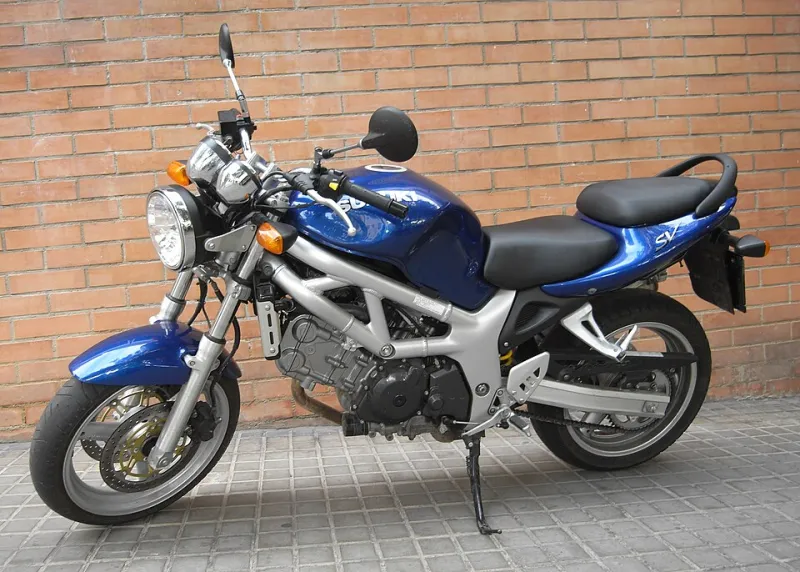
Photo: Phil Long, CC BY 2.0, via Wikimedia Commons
Nobody buys a 2004 Bandit because they enjoy admin. You buy it because it was cheap, it goes, and it does not owe you anything. Then a sign appears at the edge of a city, and suddenly the cheapest bike you ever owned has an opinion attached to it.
This is not a piece about whether clean air zones are good or bad. It is a piece about money, and about not getting a penalty notice through the door because you assumed a rule applied to somebody else.
The short version, before the detail
- London's ULEZ is the scheme that actually bites motorcycles. Non-compliant bikes pay £12.50 per day, every day, around the clock.
- Most clean air zones outside London do not charge motorcycles at all — Birmingham, Bristol and the various charging zones in the north are largely aimed at vans, lorries, buses and taxis. But the rules differ, so check the specific scheme, not a forum post from 2022.
- Scotland's four low emission zones (Glasgow, Edinburgh, Dundee and Aberdeen) do cover motorcycles, and enforcement there has been live for a while now.
- For bikes, compliance is broadly the Euro 3 emissions standard, which in practice means most machines first registered from mid-2007 onwards. Older than that and you are usually paying.
What compliant actually means for a motorcycle
Euro 3 arrived for new motorcycles in July 2007, which is the line almost every scheme draws. A bike registered in 2006 is very probably non-compliant. A bike registered in late 2008 is very probably fine. The awkward middle — late-registered older stock, imports, anything with a murky paper trail — is where the arguments live.
Two things are worth doing before you part with money:
- Put the registration into the official vehicle checker for the scheme you care about. For London that is the TfL checker; for Scotland it is the national low emission zone checker.
- Look at the V5C. If the emissions standard field is blank or the checker throws up a surprise, ask the manufacturer for a certificate of conformity. It is a dull email that occasionally saves you a few hundred quid a year, and it is the only thing a scheme operator will accept as proof that their database is wrong.
If you are buying used, do that check before you hand over cash, not after. A £2,000 commuter that costs £150 a month to bring into town is not a £2,000 commuter.
The arithmetic that decides it
London is where the sums get ugly. Five days a week inside the zone is roughly £260 a month, or £3,000 a year, in charges alone — before fuel, insurance, tyres or the endless chain and sprocket habit.
The daily charge is per day, not per entry, so a rider who pops in and out four times on a Tuesday still pays once. That helps a little. It does not help enough. And unlike cars, there is no residents' discount for motorcycles, which catches out plenty of people who move into a borough and assume their 2003 hack is grandfathered in.
So the honest question is this: are you riding into a charging zone daily, weekly, or twice a year?
- Twice a year: pay the charge, enjoy the day out, stop worrying.
- Weekly: do the annual maths. Ten days a month is £1,500 a year, which is real money but not necessarily mad money if the alternative is a train season ticket.
- Daily: you are effectively funding a second motorcycle. At that point a compliant used commuter starts paying for itself within a season, and you keep the old bike for weekends outside the boundary.
The traps worth knowing about
Penalty charges, not the daily fee, are where people really get stung. In London an unpaid day typically lands as a £180 notice, reduced to £90 if settled quickly. Scotland's zones work on a lower headline figure that escalates for repeat offenders, which is a quietly effective way of making sure nobody treats it as a subscription.
A few practical habits:
- Set up auto-pay or an account with the scheme if you use it more than occasionally. Most operators will bill you automatically once a vehicle is registered, which removes the whole memory problem.
- Read the boundary signs properly. Zone edges rarely follow the ring road you think they do, and the camera does not care about your intentions.
- Do not assume a motorcycle exemption exists because a scheme's name mentions vans. Check the vehicle categories in the scheme's own documentation.
- If you ride an older machine that is genuinely historic — pre-1983 in London's case, with different rules in Scotland — check the exemption wording rather than relying on the general historic vehicle exemption you half-remember.
Can you just clean up an old bike instead?
Not really, and this is the bit that disappoints people. Retrofitting a catalyst or an engine management change to a motorcycle is not recognised by any of the UK schemes in 2026. There is no approved route to compliance for a non-compliant bike, so the choice is pay, park it, or replace it.
That said, if the bike is otherwise sound, keeping it for everything outside the zone is a perfectly rational plan. Plenty of riders run a cheap compliant commuter for the weekday grind and keep the interesting machine for the weekends, and the sums work out better than scrapping something you love.
The realistic verdict
An older bike is still viable for urban riding in 2026 — just not blindly. Check the registration before you buy, check the specific scheme before you ride in, and be honest about how many days a month you are actually crossing that line. Do that, and the twelve-fifty question answers itself.