The Bike They Walk Past: Layering Security Without Lying to Yourself
There is a moment, usually after the first near-miss or the first insurance renewal that makes you wince, when you start shopping for security. You look at chains, disc locks, anchors, trackers and alarms, and the marketing tells you each one is the answer. The honest answer is that none of them is. Security is not a single purchase. It is a stack of small, imperfect obstacles, and the trick is making your bike enough hassle that someone else's looks easier.
That is not a cheerful sales pitch, but it is a useful one. Britain's bike theft problem is real, it is concentrated in particular places and particular habits, and it is not solved by buying the most expensive chain on the shelf and hoping. It is solved by understanding what each layer does, what it does not do, and where you are asking too much of it.
First, the uncomfortable truth
If someone arrives with a van, a battery angle grinder and five uninterrupted minutes, they will take the bike. That is true of almost every lock sold. The point of security is not to make theft impossible. It is to add time, noise, visibility and risk. A thief wants a quiet, quick, low-attention job. Every layer you add makes your bike a worse prospect than the one three streets away with a single disc lock and a cover flapping in the wind.
So stop thinking in terms of whether a lock is 'safe'. Think in terms of how long it buys you, how obvious it makes the attack, and whether it forces the thief to carry more equipment or make more noise. Those are the currencies that matter.
Where bikes actually disappear
The pattern is depressingly familiar. A lot of theft happens at home: driveways, front gardens, communal parking areas, outside flats, under windows. Then there is the commuting routine — the same station car park, the same office rack, the same spot on the street every day. Town centres and busy parking bays account for plenty too, often in daylight, often from a bay that looked fine because it was near a shop.
Cities such as London, Birmingham, Manchester, Leeds and Bristol get the headlines, and they earn them. But theft is not only a big-city problem. Market towns and suburban streets see it too, especially where bikes are left in the same place at the same time each night. If your bike is parked in a predictable spot, it is on a timetable whether you meant it to be or not.
The lock hierarchy: what each thing does
A disc lock is a good visual deterrent and a cheap one. It stops the casual roll-away and the hot-wire-and-push merchant. It will not stop two people lifting the front end into a van. Use it on the rear disc where possible, use the reminder cable so you do not ride off with it on, and accept it as a first layer rather than the whole plan.
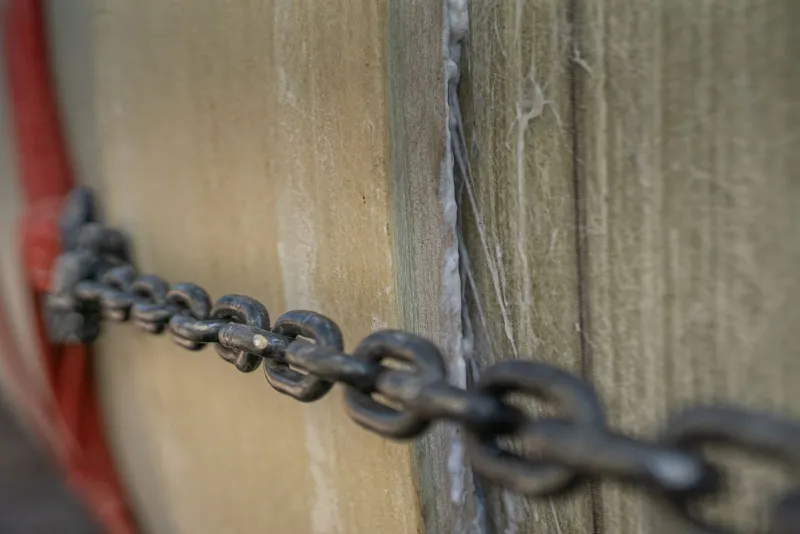
A chain and padlock is the workhorse. Look for a Sold Secure rating that matches how you are using it, and be realistic about thickness. A heavy 16mm-plus chain is a home anchor tool; a 10-13mm chain is more portable but still useful. Keep the chain off the ground and as tight as you can. A loose chain gives a thief leverage and room to swing a grinder. A tight chain is much harder work.
A D-lock or U-lock is excellent for locking the frame to a fixed object. The weak point is usually the thing you are locked to, not the lock. A cheap bike rack, a wooden post or a sign that lifts out of the ground is not an anchor. It is a prop.
A ground anchor, properly bolted into concrete or a paving slab with the right fixings, is one of the most underrated bits of home security. It turns a portable chain into a fixed point. If you have a garage or a yard, this is where the money goes before the second tracker.
Alarms and immobilisers make noise and complicate a quick theft, but most people ignore alarms. Treat them as a nuisance layer, not a guarantee. Trackers are different: they do not prevent theft, they help recover the bike afterwards. They are worth it if you accept the subscription and the limitations. A tracker hidden badly is just another thing to rip out.
Marking kits such as DATATAG or SelectaDNA do not stop a bike being taken, but they make it harder to sell on cleanly and easier to identify if it comes back. The stickers are part of the point. So is the fact that a thief knows the bike is marked.
Layers that work together
At home, the aim is to make the bike difficult to move and difficult to work on unseen. A garage or shed with a decent lock, a ground anchor, a chain through the frame, a cover and a tracker is a solid stack. Do not leave keys in the hall by the door. Do not leave the garage remote in the car. Do not advertise a nice bike on social media with your street name in the background.
Out and about, use two different types of lock where you can — a chain and a disc lock, or a D-lock and a chain. Park where people can see the bike, ideally under lighting or CCTV, and avoid the quiet corner that feels safer because nobody is watching. If there is secure parking at work, use it even if it costs a few quid a month. If there is not, vary your spot when you can.
When commuting, take the keys with you, take the expensive helmet with you, and do not leave panniers or top boxes full of tempting kit. A cover is not just weather protection; it stops a passer-by seeing what is underneath.
What insurers actually expect
This is where a lot of riders come unstuck. If you tell your insurer the bike is kept in a garage, it needs to be in the garage. If you declare a Sold Secure lock or a tracker, you may be expected to use it and prove it. Keep receipts. Keep the packaging or take a photo of the lock and the rating. Read the theft excess and the security conditions on your policy, not just the headline premium.
If the worst happens, report it to the police, get a crime reference number, tell your insurer promptly, and preserve any CCTV or witness details. Do not chase or confront anyone. A bike is replaceable. You are not.
The honest limit
Spend in proportion to the bike and your risk. A £600 lock set on a £1,500 commuter is not sensible; a single disc lock on a £12,000 adventure bike in a city is optimistic. Insurance is a layer too, and sometimes the most rational one. The goal is not to win an arms race. It is to make your bike a harder target than the next one, and to know exactly what each layer will and will not do when someone decides to try.