Below Ten: The Riding Skill Nobody Films for the Algorithm
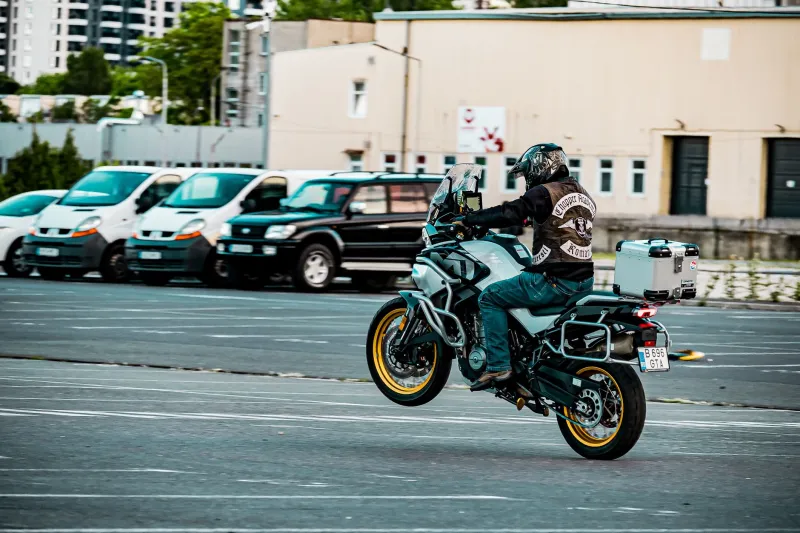
There is a strange pecking order in British biking. Knee-down photos get the likes, track days get the bragging rights, and a tidy set of tyres earns more respect in the café queue than almost anything else. Yet spend a season listening to riders talk about their worst moments and a pattern emerges. The drama rarely happens at 70 mph on a sweeping A-road. It happens at 4 mph on a petrol station forecourt, halfway through a U-turn, or while creeping towards a junction with a white van edging out.
Low-speed control is the unglamorous core of being a competent rider. It is also the part most of us stop practising the moment we pass our test. That is a shame, because the skills involved are not mysterious. They are just uncomfortable to rehearse — especially when you feel like everyone in the car park is watching.
The car park is the classroom
You do not need a track, a trainer, or a full Sunday. You need ten minutes, an empty patch of tarmac, and the willingness to look a bit daft. A supermarket car park after hours is the classic choice, but check the signs and local rules first. Private land needs permission. A quiet industrial estate on a Sunday morning can work just as well, provided you are not annoying anyone or treating the place like a playground.
Set out a few markers — tennis balls cut in half, small cones, or even pairs of gloves — and give yourself a simple circuit. Ride at walking pace in a straight line. Perform figure-eights. Practise full-lock turns in both directions. Do controlled stop-starts. Thread through a slalom with generous spacing at first, then tighten it. Ten minutes of this is genuinely tiring, which tells you something about how much work your hands, clutch, and brain are doing.
The goal is not to look impressive. The goal is to make the bike feel calm when there is no speed to hide behind.
Friction zone, rear brake, and the art of going nowhere
At low speed, the clutch is your throttle. Find the friction zone — the point where the lever starts to bite — and keep it there. A steady, small amount of throttle plus a controlled clutch gives you drive without lurching. The rear brake is your speed regulator. Dragging it lightly keeps the bike settled and stops you from surging forward when the clutch bites harder than expected.
This combination feels alien if you have spent years using the clutch only to pull away. In a car park, it becomes second nature. Keep your feet up once you are moving. Look where you want to go, not at the front wheel. Turn your head properly; a U-turn is as much a neck exercise as a handlebar one. Keep your arms relaxed and let the bike lean underneath you.
The front brake is not the enemy, but at very low speed it demands respect. A grab can tuck the front and put you on the floor before you have time to think. Use the rear for control and save the front for proper stops.
U-turns without an audience
British roads are full of places where a U-turn is the sensible option: a dead-end lane, a missed turning, a village street with no roundabout for miles. They are also full of kerbs, cambers, and parked cars that make the manoeuvre feel tighter than it is.
Practise on both sides. Most riders have a favoured direction and quietly avoid the other. That is exactly the direction that will catch you out when a narrow Victorian street offers no alternative. Start wide, use the whole available width, and keep the rear brake covered. If you feel the bike tipping too far, do not snatch the clutch or stab the front brake. Ease off, let the bike stabilise, and try again.
A dropped bike in a car park is a lesson. A dropped bike in front of a bus queue is a story you will hear about at every bike night for the next five years.
Junctions, filtering, and the slow crawl
Tight junctions are low-speed exams in disguise. You are managing a clutch, a rear brake, observations, and a blind exit all at once. Riders who practise slow control tend to arrive at the line feeling settled rather than frantic. They can creep forward a few feet, stop, look again, and go without wobbling.
Filtering is the same skill in a different costume. Crawling between lanes of traffic is not about bravery; it is about precision. Keep the speed low enough that you can stop within the gap you can see. Cover the front brake. Use the rear to steady the bike. Do not commit to a gap just because it is there — commit because you have looked, judged, and know you can stop.
The riders who make filtering look easy are usually the ones who have spent time going nowhere slowly in an empty car park. There is no magic to it. There is just repetition.
Why this is the real advanced test
Advanced riding is often framed around pace, positioning, and reading the road at speed. All of that matters. But the measure of a confident rider is not how quickly they can dispatch a B-road. It is how calmly they can turn a heavy bike around on a narrow street, stop exactly where they intended at a junction, and creep through a gap without clipping a mirror.
In 2026, with roads busier and junctions more cluttered than ever, those small skills matter more than ever. They are also the ones that keep your confidence intact. A rider who has dropped a bike at low speed knows how quickly the doubt sets in. A rider who has practised the awkward stuff knows they can recover.
A ten-minute weekly plan
Warm the bike properly. Check your tyre pressures. Find your empty patch of tarmac. Then spend two minutes on straight-line walking pace, two on figure-eights, two on U-turns in both directions, two on stop-starts, and two on a slalom. That is it. Ten minutes, once a week, and you will feel the difference within a month.
Do not turn it into a session. Do not invite an audience. Do not film it for the algorithm. Just go and practise the speed you cannot brag about. It is the speed that will keep you upright when it matters.